PulseQuest
A data-driven quest system for Unreal Engine, built on StateTree.
Get Started Learn View on GitHub
What is PulseQuest?
PulseQuest is an Unreal Engine plugin for quests and objectives. The logic of a quest is a StateTree; the runtime runs quests on the server, replicates their data and objectives to the owning client (or to all players of a shared quest), saves and loads them and exposes everything to UI through MVVM view models. New here? The short lessons in Learn build your first quests step by step.
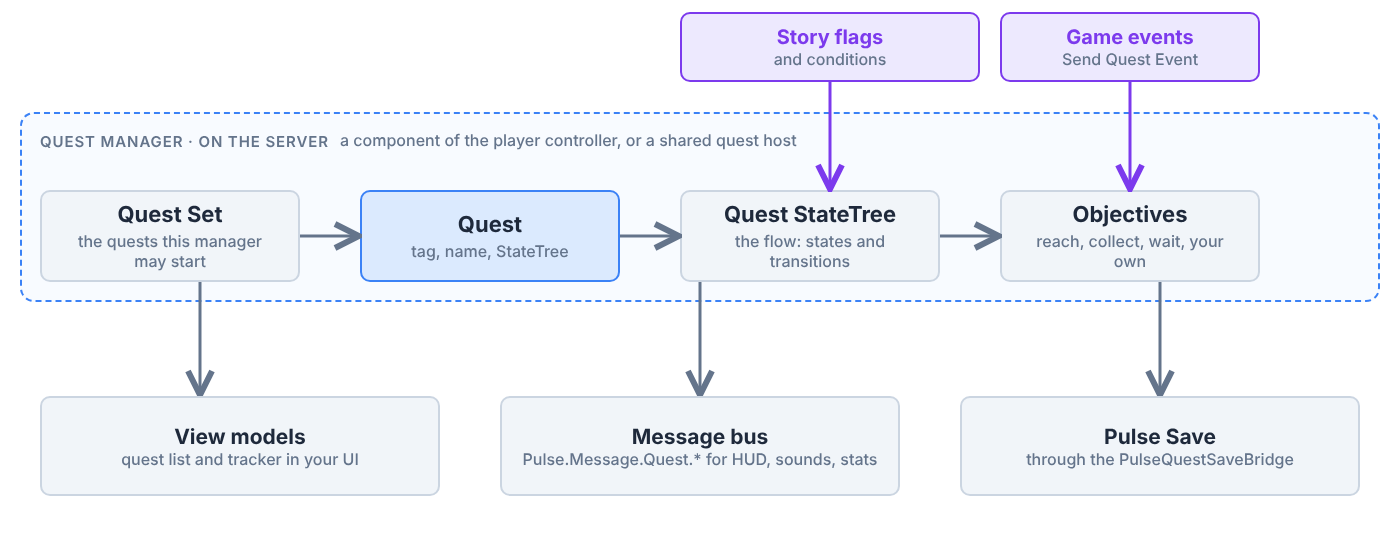
Features at a Glance
| Feature | Description |
|---|---|
| StateTree quests | A quest is a UPulseQuest data asset with a StateTree (schema Pulse Quest) |
| Quest catalog | Quests by tag through the definitions of PulseFoundation: assets, quests made at runtime, quests from templates, daily quests of a backend through a catalog of your own |
| Objectives | UPulseQuestObjective objects with display text, replicated progress, markers, gameplay tasks and net modes; ready-made Gameplay Event, Reach Location, Timer and Wait For Input objectives |
| Gameplay events | Gameplay reports events once (Send Quest Event, a message on Pulse.Message.Quest.GameplayEvent), objectives and StateTree tasks count them |
| Story flags | Replicated and saved story decisions, shared by quests, director, conditions and dialogs |
| Conditions, rewards & history | Start conditions and rewards on quests (Pulse conditions and rewards of every plugin), replicated and saved quest history for story branches, repeatable quests and one-time tutorials |
| Quest director | Optional server side story controller (UPulseQuestDirector, UPulseQuestStateTreeDirector) that starts and ends quests |
| Multiplayer | Per player quest manager (owner only replication) and APulseSharedQuestHost for party quests; clients follow resets and restarts reliably |
| Save/Load | FPulseQuestSaveGame with load priorities and class-mismatch handling, async Blueprint nodes |
| PulseSave | Quest managers and shared hosts save themselves as bytes: PulseSave keeps them without a bridge |
| Dialog bridge | Optional PulseDialogQuestBridge plugin: dialogs and cutscenes in quests (PulseDialog) |
| Gameplay bridge | Optional PulseQuestGameplayBridge plugin: objectives that gather and deliver items, defeat enemies and count interactions (Pulse Gameplay) |
| Online bridge | Optional PulseQuestOnlineBridge plugin: one shared quest host per party of Pulse Online (party quests) |
| AI bridge | Optional PulseAIQuestBridge plugin: quest tasks that spawn and steer AI agents, objectives to defeat an AI group or escort an agent (Pulse AI; documented in the Pulse AI docs) |
| MVVM UI | View models for the quest manager, its data, quests, objectives and the tracked quest (module PulseQuestMVVM) |
| Blueprint friendly | Quest manager functions, objective events and async nodes are Blueprint exposed |
| Data validation | Quests (unique tags, schema), quest sets, quest managers, objectives and quest StateTrees (objective save ids) validate in the editor |
| Diagnostics | stat Quest stat group and the LogPulseQuest log category (also Visual Logger) |
At a glance
| Step | In this plugin |
|---|---|
| Set Up | 3 required (Add the Pulse Quest Manager component to the Player Controller; Give the quest managers a quest set; Save quests once, so they are known by their tag), 5 optional |
| Create | Quest, Quest Set, Quest StateTree, Quest Objective, Quest Director, Quest Director StateTree; starter content |
| Test | Example map LV_PulseQuest_Example, cheat PulseQuestGrant |
| Check | Pulse window, Check All, -run=PulseCheck |
Documentation Sections
- Getting Started – Set Up, Create, Test, Check
- Architecture – Modules, runtime objects, event queue
- Quest Manager – Component, shared host, parameters, API
- Quests & Quest Sets – Data assets, flags, quest data, quest instances
- Quest Catalog – Quest ids, quests made at runtime, templates, daily quests
- Objectives – Lifecycle, saving, net modes, gameplay tasks
- StateTree Integration – Schemas, context data, tasks, conditions
- Gameplay Events & Story Flags – Events for quests, story decisions, tracked quest
- Quest Director – Story director, StateTree director, load behavior
- Save & Load – Save game format, save interface, async nodes
- PulseSave Integration – Saving quest managers with PulseSave
- Pulse Gameplay Integration – Objectives for items, enemies and interactables
- Pulse Online Integration – Party quests with a shared host per party
- Multiplayer – Replication, authority, shared quests
- MVVM & UI – View models and bindings
- Settings – Project settings
- Console – Cheats, console variables, stats and log categories
- API Reference – Class and function overview
Blueprint examples are shown as numbered node steps until a rendered graph is added (see docs/_data/blueprints.yml).
Supported Platforms
Unreal Engine 5.8 or newer.
| Platform | Status |
|---|---|
| Win64 | Supported |
| Mac, Linux | Enabled, not tested |
Dependencies
PulseQuest enables these Unreal Engine plugins: StateTree, GameplayStateTree, ModelViewViewModel, EnhancedInput and DataValidation. It also uses the GameplayTags, GameplayTasks and DeveloperSettings modules.